
France is known for many things, like the Eiffel Tower, romance, vineyards, castles, and cafés. And it’s also known for its amazing food. Here are a few bites you shouldn’t pass up on your trip to France. These are only a few must-try foods of France, but it’s safe to say that there are many more to discover!
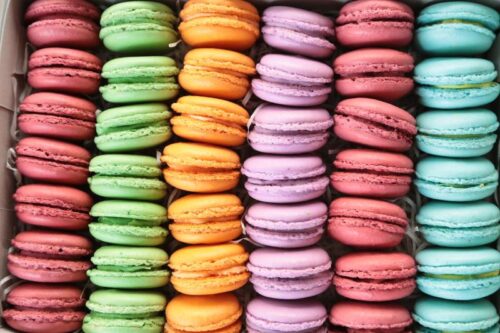
Macarons
Macarons — also called French macaroons, not to be confused with coconut macaroons — are two meringue cookies sandwiching a flavoured filling. These cookie sandwiches showed up in Paris in the 1830s from Parisian confectioners and were made popular by Ladurée, a famous French bakery. It wasn’t long until the macaron became famous world-wide. It even has its very own day to celebrate! But even though these tasty treats are accessible just about everywhere these days, there’s something special about trying them in the country where they originated.
Croissants
Croissants are a staple food of France. They are convenient, easy to eat on the go, and can be enjoyed in a multitude of ways, including on their own, as part of a sandwich, stuffed with filling, or sprinkled with toppings. Some say that you know a croissant is good if you don’t need to add anything to it. However, French people like to indulge at their weekend brunch and add jam or chocolate to their croissants.
The croissant became popular in France because of Marie Antoinette. The story is that she wanted the baker to replicate her favourite pastry from her hometown in Austria. Over time, this baked good became lighter and fluffier, developing into what we know the croissant as now.
Baguettes
Another must-try food of France is the baguette. Before the baguette as we know it today existed, long, narrow loaves of bread were baked as early as the 1600s. In the late 1800s, the invention of the steam oven allowed bread to expand more rapidly. The French government finally established official regulations for the production of baguettes in 1920, specifying the length, weight, and composition of the bread.
The baguette has been an iconic symbol of France ever since. Like the croissant, it’s a great grab-and-go snack that’s versatile in the ways you can enjoy it. One way people will enjoy a baguette is to cut it in half with butter and jam. It also pairs wonderfully with chocolat chaud, cheeses, or olive oil and balsamic vinegar dip.
Butter
This is a unique one, but the butter in France is a must-try, specifically Le Beurre Bordier, which originates from Saint-Malo in Brittany. This butter is truly different from the rest! They only use milk from local farmers who demonstrate the best farming practices. They also take their time when making the butter. Bordier waits 72 hours to use the milk once they get it from the cows, whereas milk used to make a typical brick of butter is only left to sit for six hours. This extra time allows the cream to develop its flavour. They even knead the butter at a much slower speed.
It’s also unique because the butter is slightly different based on what season it is. The cows’ diet vastly alters how the butter comes out. When the cows graze on fresh grass in the summer, the butter is much yellower, smoother, and tastes more savoury. In the winter, the butter tends to be lighter in colour, more brittle, and sweeter.
Bordier also only makes the butter on-demand, so you know you’ll be getting the freshest butter!
French Onion Soup
French onion soup is a comforting staple that has become widely popular. There are no definitive stories on the origin of French onion soup, but many think that in the 1800s, low-income workers would use the leftover onions they were selling and make soup to keep them warm. The soup started as just the broth, which uses caramelized onions and beef broth.
In the 1900s, people started seeing this dish in restaurants. The recipe expanded with the addition of bread layered with cheese on top, followed by baking until crispy and golden brown.
Cheeses
And of course, some of the most iconic must-try foods of France are the country’s cheeses!
Two well-known soft cheeses are Brie, from the Brie region southeast of Paris, and Camembert, from the town of the same name. Both of these creamy cheeses are perfect for pairing with a baguette and a glass of white wine.
Comté is a popular unpasteurized hard cheese that pairs better with bolder red wines. It originates from eastern France, near the Swiss border, and is actually sometimes called Gruyère de Comté. Its production is based on artisanal techniques developed in the Jura Mountains 1,000 years ago, and is the largest of the Protected Designation of Origin (PDO) cheeses made in France.
Lastly, Roquefort is a famous blue cheese made from sheep’s milk in the south of France. Its flavour shines best when paired with something sweet.